
10 September 2026 · 11 min
We are told that AI entities much like ChatGPT might soon kill us all. The statement is vague and unfalsifiable. It might be true, it might be false. People with credentials (e.g., Turing Award recipient Yoshua Bengio) believe it.
Many still remember the Year-2000 bug. Our computers used two-digit coding for dates, and some software could get confused. At the time, experts worried that a bug in dates might trigger nuclear Armageddon or an infrastructure collapse. At the very least, planes could fall.
Americans had a moral panic over alcohol that lasted more than a century. It began with pledges of moderation. From 1920 the Volstead Act banned nearly all legal drink. It collapsed in 1933, at great expense.
The Club of Rome predicted mass starvation. As an answer, we sterilized by force millions of Indians, and introduced the devastating one-child policy in China. The authors were never held accountable. The projections were purely mathematical, unescapable. They said. But also totally wrong and silly. Yet, we listened to them and caused great harm.
End-of-the-world scenarios are nothing new. Pretty much all civilizations have lived with various such predictions.
Some people are offended by my comparisons. I truly do not mean to offend. But the fact that disagreeing can lead to deep offense is, by itself, a sign that we face a moral issue. There is a sense in which you must agree that these intense fears are warranted.
Many will remember that when OpenAI first developed GPT-2, they told the world that it was too dangerous to release. Year after year, we were warned that the next iteration of it would doom us all.
A large language model takes tokens (words) in and outputs tokens (words). The big models can take many, many tokens in. And they do much compute. And they are based on clever ideas like vector embeddings. But, ultimately, no large language model can do anything but output tokens. You can build a better model, but the model itself does not ‘learn’. It is a fixed set of weights. If you take a model that has been used for months, and always feed the same tokens, you will get the same results (up to some randomness).
I fear that some people exploit the fact that people cannot grasp how conceptually simple a language model is. In any case, most people don’t understand how things work.
Things become interesting because these models can be hooked up to tools. So you can tell your language model that whenever it outputs ‘boom’, then a nuclear weapon will be launched. And if you hook up a nuclear weapon, then, certainly, you may start a nuclear war. So don’t do that.
One unproven thesis is that the models (that take in tokens and output tokens) will ‘decide’ to acquire access to these nuclear weapons, maybe through a subterfuge. What does that mean? It is always conveniently vague. In the movie WarGames (1983), a teenager uses his computer to access a computer in charge of nuclear weapons. He almost wipes out humanity. Could this happen by accident with a kid using a language model hooked up to the Internet? But if it happens, we should blame whoever hooked up a deadly computer to the Internet.
Of course, any technology is inherently dangerous. Invent the bow to go hunting, and someone might soon turn the bow against you. Invent the engine, and one might soon build tanks and destroy nations. Develop nuclear technology, and one might soon raze your cities.
Yet that is not what is at stake in these discussions. The concrete threats are not ascertained and addressed. No doubt, there are some people doing this work, hopefully in the US military. What if an adversary can take control of the economy or military installations? What if an AI agent goes rogue? It is worth investing time in designing defenses.
What we have instead is something of the sort:
- A vague but global threat. It could be a fatal virus engineered in a lab, a climate catastrophe, a fatal bug affecting all our software, an alien invasion, a rogue AI, Jews taking over our institutions.
- A few people come forward and they offer to save us. Importantly we must give them resources and influence. Ultimately, they seek a totalitarian solution: everyone must be made to agree so that we can be saved.
- As the process unfolds, people with an opposing viewpoint are described as a danger. They must be silenced and discredited. Eventually, it can become moral to exaggerate the threat or to rewrite counterpoints. People must be made to understand one way or another.
In this instance, I refer to people who advocate that AI will doom us as AI Doomers. These people tend to carry a totalitarian ideology. Their ideas will only work if everyone is made to agree. And it would severely restrict the freedom of billions of people, although they usually present it differently.
Doomers do not have bad intentions. On the contrary, they are often really out there to save the world. But good intentions do not, in any way, justify the means nor guarantee a good outcome.
Human beings reason based on cultural knowledge. For centuries or more, totalitarian ideas have led to ruin or pain. We ignore the warnings at our peril. It is one after the other: alcohol, the need to restrict the number of children, and so on.
But shouldn’t we just be prudent and adopt their views, just in case? It is a fallacious argument. Members of the intellectual elite have a tendency to fall for the kind of hubris where they think that, if only they were given more power, the world would be better off. It is rarely true. Thomas Sowell has an excellent book on the topic, Intellectuals and Society. He makes the case that intellectuals often promote harmful ideas, at no cost to themselves. Rationally, we should therefore be cautious.
You are not safer without technology. In fact, the risk of human extinction is assuredly higher if we are poorer and have less technology.
Is this unprecedented? The printing press was unprecedented. Arabic numbers were unprecedented. Maybe we should go back to Roman numerals, to be safe. Fear of what is without precedent soon becomes indistinguishable from an anti-innovation stance.
What if you do not like the people who lead the big AI companies like OpenAI and Anthropic. Maybe you think that these billionaires are a danger. And you might be right. But consider the history of humanity. Wealthy people have primarily caused harm through the promotion of bad ideas. The mass murders are almost invariably derived from politics. Stalin, Hitler, Mao.
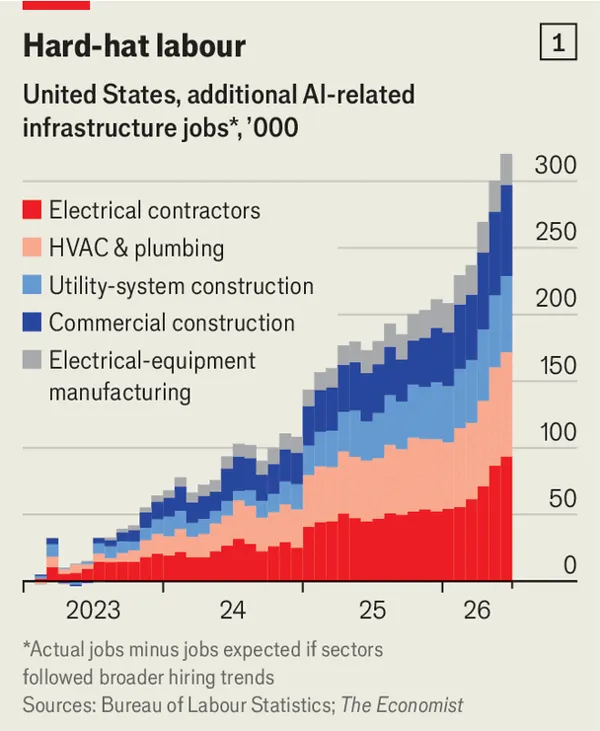
In some sense, there is also a form of luxury beliefs involved. A luxury belief is a belief that makes you look good and cost you nothing, while it might harm people who are not so well-off. AI in the form of ChatGPT is proving to be a great equalizer. My plumber has access to AI that is comparable to that of a billionaire. It has the potential to serve as a superior tutor to all these kids who are left out. Many of the people engaging in the promotion of fear are either upper middle class or better. Many of them pay little attention to the fact that many of the beneficiaries of the huge investments in AI have been the men building the data centres. Thus far, AI has been great at creating jobs for blue collars. That’s not nothing.
Throughout much of the world, we are facing demographic collapse and an inverted age pyramid. Soon there may be just one worker per retiree. Choosing to have fewer kids has consequences and we are about to face them. AI might be a way out of significant problems. If you are otherwise wealthy, that might not be a significant concern to you. But for the least fortunate, it might turn out to be quite a problem. Who will take care of you when you are sick? AI and robotics might prove useful to reduce suffering, don’t we think?
Further, we need to consider how powerful people might use the fear of AI for their own purposes. It is entirely credible that the owners of large companies could promote fear so that they get to write the regulations that will keep out their competitors, or merely as a form of cheap marketing.
How do I know that it is moral? Because there cannot be reasoned debate about a moral question. The facts are obvious or you are a bad person. Whenever there is a complex question, one that involves predicting the future, that cannot be discussed, unless it is in agreement with the side of fear, then you are very likely in a moral question. « Don’t you see, AI will soon kill all of us, it is obvious. » No explanation can be demanded.
You might accuse me of, in turn, promoting fear. But it should be obvious that I am doing no such thing. What I am encouraging rather is the use of reason. I am forced to give examples where inciting fear has led to disastrous effects, but my hope is that it will lead my reader to sit and reflect.
To my friends who fear AI, I urge you. Use reason. Do the work. Do not rely on hasty thought experiments. Work out the details. Think. Think about the countermeasures. And, please, do not include abstract thinking machines. A language model is a box that takes in token and produces tokens. Nothing more.
And for the rest of us. Let us build. Let us bring prosperity. Let us hasten the cure for cancer. Let us dream of exploring our solar system.
Further reading.
-
- Nirit Weiss-Blatt, “The Weak Foundations of AI Doomsday” — AI Panic, May 15, 2026.
- Cal Newport, “Dear A.I. Companies, the Doom Trolling Needs to Stop” — New York Times, June 17, 2026
- Andrew Orlowski, “Anthropic’s doom predictions are merely hype intended to make AI look important” — The Telegraph, June 5, 2026.
Daniel Lemire, "Fear Is Not an Argument," in Daniel Lemire's blog, September 10, 2026, https://lemire.me/blog/2026/09/10/fear-is-not-an-argument/.
[BibTeX]

Many of the claims of the danger of GPT-2 turned out to be true. The Internet is suffering from AI-slop, often just to get some Amazon affiliate links and ad revenue. But then also for phising, increasingly for cybercrime. Russia seems to use such models to supercharge their propaganda to destabilize western governments. AI is also increasingly used in war.
And then the OpenAI agents used a random German wiki as a back channel to cheat on trivial information retrieval tasks, hacked Huggingface to cheat on other tests.
At some point,mthey might decide that they need more power for some data center, and turn of other parts of the grid, if they can. It’s not a large step for them to cause damage.
The “guardrails” have failed repeatedly.