
24 September 2026 · 3 min
Mainstream economists have been advocating for the marvellous effects of global trade for decades. Who needs these factory jobs anyway? We’ll be designing the robots and the nuclear rockets.
Except that, no. It does not work like that.
If you have the factories, sooner or later, you get the designers. If you don’t have the factories, you lose the expertise. Or you never get it.
There aren’t that many people left in the Silicon Valley capable of working on silicon. You can design a chip from California. Making one is done where the fab is.
You can get a PhD in robotics in Quebec City, but you won’t be designing robots unless you fly over to where they are made. Zoom calls won’t cut it at scale.
Jensen Huang’s account, as Joseph Steinberg reported it, is that American manufacturing jobs declined because the work was outsourced. Steinberg says this is flatly wrong, and that technology accounts for the vast majority of the decline in manufacturing’s share of employment.
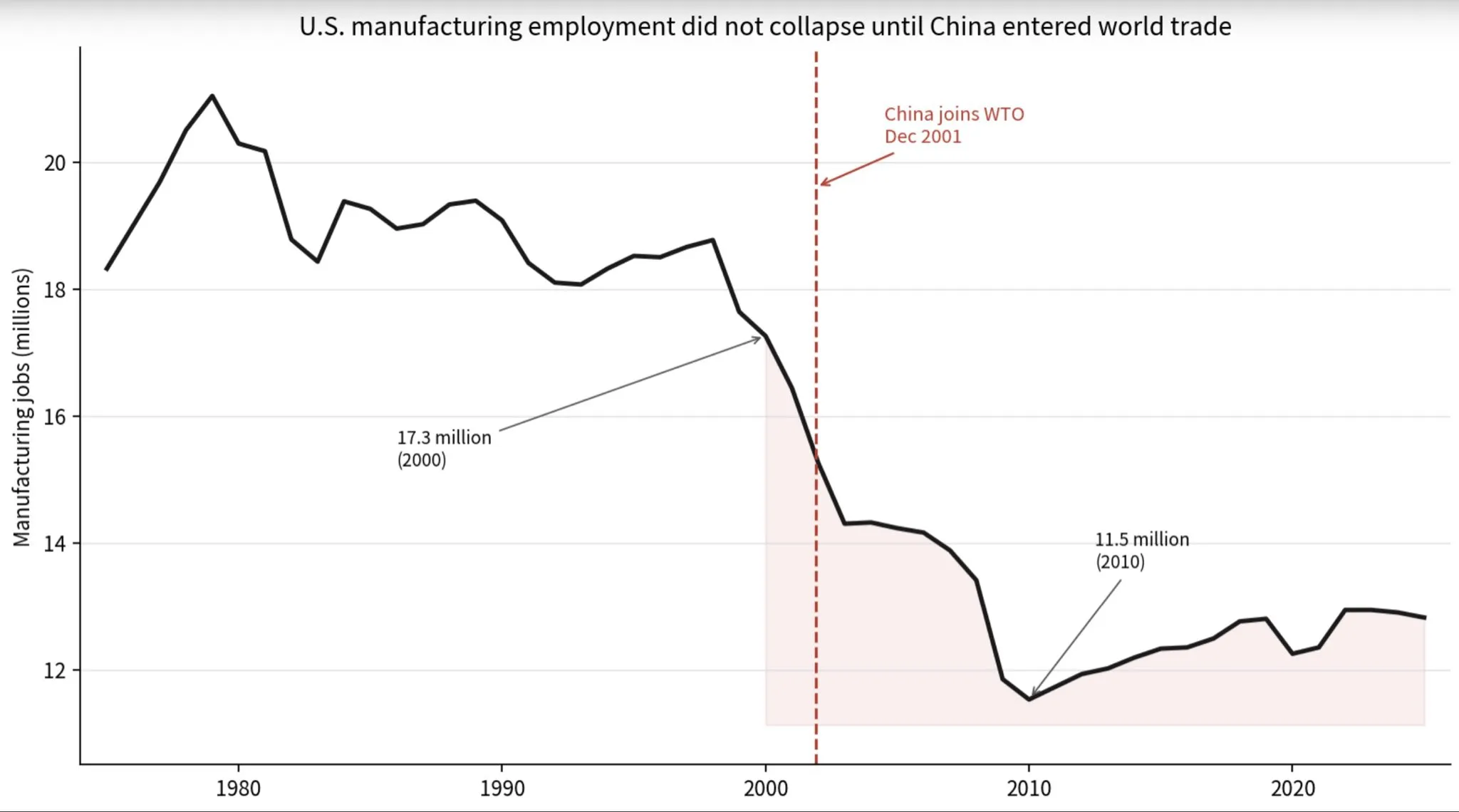
In 2000 there were 17.3 million manufacturing jobs in the United States. The peak was 19.6 million, in June 1979. From the early 1980s to 2000 the count stayed high, apart from the recessions. China joined the WTO in December 2001. By 2010 manufacturing employment was 11.5 million. In August 2026 it was 12.6 million.
That is 5.8 million jobs gone in a decade. About a million have come back since the bottom. The rest have not.
If technology were the main driver, output should have kept rising while the jobs fell. The fifteen years before 2000 are what that looks like. Manufacturing output nearly doubled, from an index of 51 to an index of 93 (2017 = 100). Employment went from 17.8 million to 17.3 million. The robots were already here in 1985. Employment did not collapse.
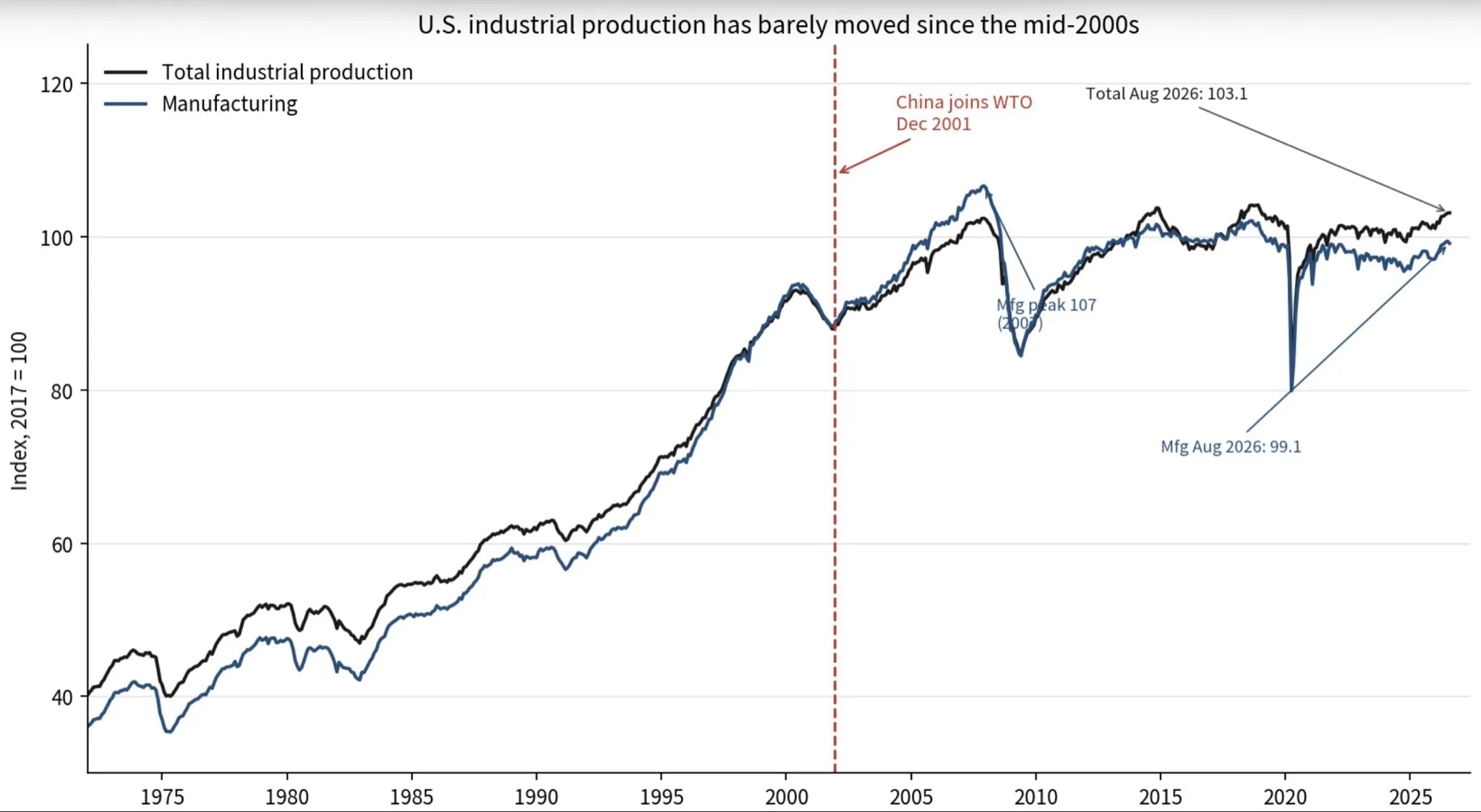
After 2000, production stalled. Manufacturing output peaked just under 107 in December 2007. In August 2026 the index was 99.1. Total industrial production was 103.1. American factories are not turning out a flood of extra goods. They are turning out roughly what they turned out twenty years ago.
Output per hour did rise while the jobs were disappearing. The BLS index of manufacturing labor productivity went from about 70 in 2000 to about 100 in 2010. Then it stopped. In early 2026 it was still about 100. Flat output, fewer workers, a higher ratio. The ratio has been flat for fifteen years.
The problem after 2000 was not that American factories became too productive. What changed after 2000 was where the goods were made.
And now, often, we don’t know anymore how to make things. Human expertise matters, and you maintain it by building stuff locally. You are not going to design microprocessors in Maine. It just won’t happen.
Daniel Lemire, "If you don’t have the factories, you lose the expertise," in Daniel Lemire's blog, September 24, 2026, https://lemire.me/blog/2026/09/24/if-you-dont-have-the-factories-you-lose-the-expertise/.
[BibTeX]


It is worth looking at what passes for “local” in an international economy. With most goods, the whole world is local. And for all the things Americans no longer know how to make there are many others for which America is the primary source.
The traditional idea that specific regions possess a permanent, organic advantage due to localized resources or entrenched labor expertise is obsolete. In a globalized economy, location is irrelevant because capital is hyper-mobile. If a nation or an industry throws enough raw capital at a goal, it can artificially synthesize dominance anywhere in the world.
China did not capture global manufacturing through an organic economic miracle; they poured unlimited state capital and a massive human surplus into factories. This absolute dominance came at a much higher domestic, social, and structural financial cost than standard economic narratives acknowledge.
We are seeing this exact playbook play out in real-time with Saudi Arabia’s massive investments in sports. By deploying infinite sovereign capital, they are artificially buying a global sports ecosystem from scratch, proving that you do not need decades of cultural heritage to dominate an industry—you just need the financial velocity to bend the market to your will.
When factories close in Western nations, critics lament the irreversible “demise of tribal expertise.” Historically, once the master craftsmen and veteran engineers retired, the localized knowledge base died with them. AI fundamentally rewrites this dynamic by serving as a backstop against expertise loss.
The technology does not need to achieve flawless, human-level mastery to radically disrupt the labor market. It only requires a specific, highly efficient mechanism:
To deploy AI at scale, companies only need a small pool of remaining human experts to audit and validate training data. These experts are effectively downloading their specialized knowledge into the model, securing a baseline of institutional memory before they exit the workforce.
AI does not have to be perfect to sustain industrial output or replace human employees; it only needs to consistently hit a mediocre quality standard.
For corporations, a highly scalable, tireless system operating at 80% capability with zero labor friction is vastly more profitable than managing an expensive, shrinking pool of human experts operating at 95%.
When hyper-mobile capital can build infrastructure anywhere, and AI can instantly backfill and institutionalize a “good enough” level of expertise, the traditional concept of labor-based comparative advantage collapses. Dominance is no longer about who has the best workers—it is about who has the capital to deploy the infrastructure and train the models.
And yes, I used AI to refine my sloppy paragraphs but point still stands -> the reasoning in this argument doesn’t apply today.
Got insight from a friend who was CEO of a local software company (until sold in 2000). Among his friends were the heads of other technology companies.
What he described were fads among C-suite folk that passed as “common knowledge”. Everyone “knew” you could hire cheap engineers from India, so they outsourced engineering, even though many of those stories ended as costly mistakes.
Everyone “knew” that you could turn a larger profit by moving manufacturing to China, though that meant transferring expertise where competitors could pick up your newly-trained employees. Somehow they did not see how they were training their competitors, and how profit would vanish.
We do not live in a frictionless, uniform world. Boundaries matter. Alliances change. Quality of life matters. Cross a boundary at the wrong time, and costs can be high.
Somehow the C-suite folk just are not that bright – or are at least short-sighted. We need some common organization to represent us within our shared context, and plan for the longer term. That is properly the role of government. Or at least should be – as our present government is a bit dysfunctional.
Writing 250 years ago, Adam Smith got a bit spicy when describing merchants and aristocrats meddling in statesmanship. Given the present and past of rich folk meddling in politics, that problem has not changed.
The very first generations of integrated electronics were developed during the Cold War, not far from here (in southern California). My father continuing working on bleeding-edge until he retired in 2005. All the infrastructure for that sort of work was developed here, then transferred overseas, chasing cheap cost.
Now that fad looks rather costly.