
4 October 2026 · 1 min
Much of my research is on arXiv. I was one of the early adopters. It is simply a repository of research papers with PDF and metadata.
It makes it convenient to find research without any paywall.
Physicists started it in 1991. Math and computer science followed gradually.
It relies on volunteers to moderate it, because we don’t want garbage or spam.
On October 1, they capped the submissions to two per person per month.
Why?
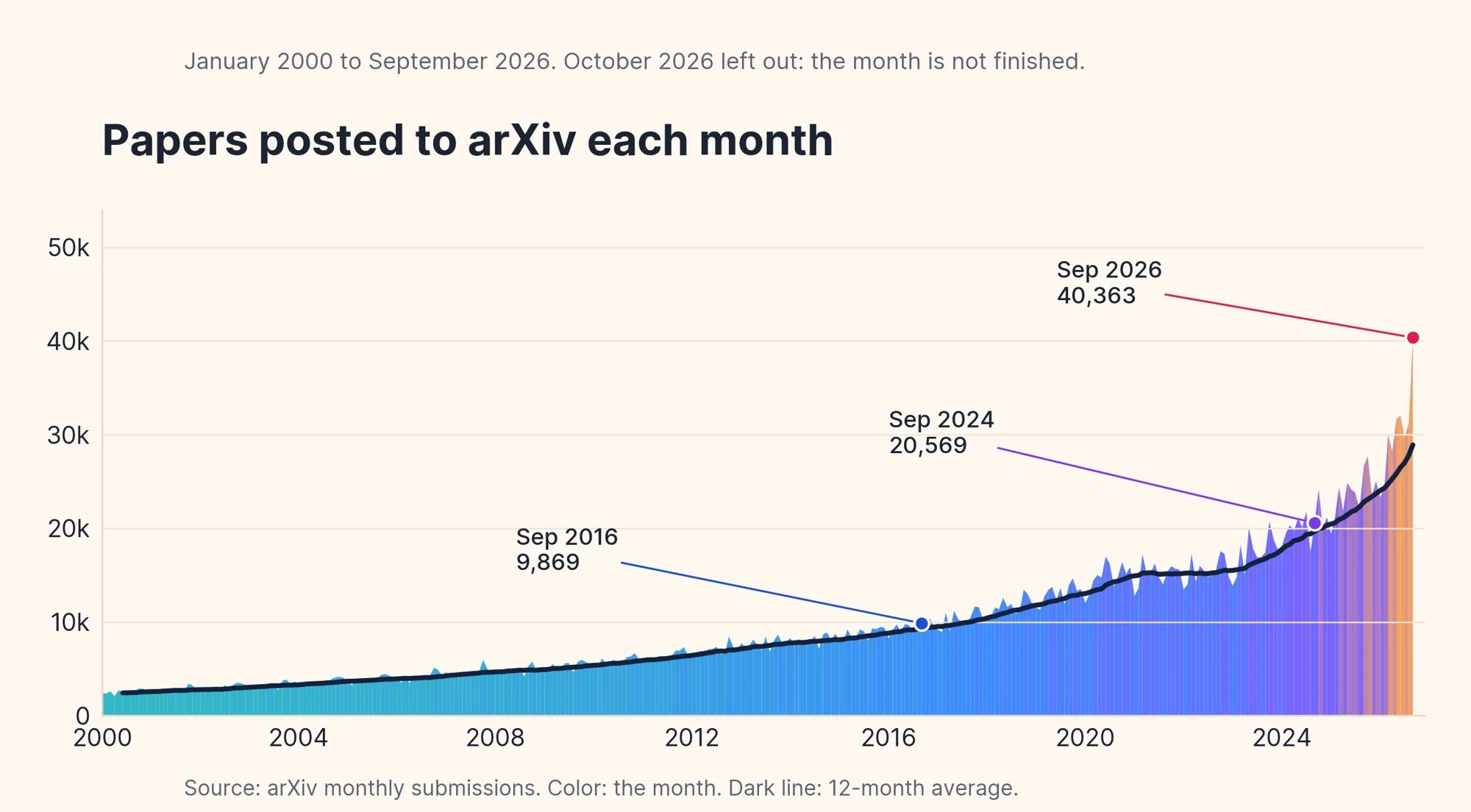
arXiv got over 40,000 submissions in September.
Two years ago, it was about 20,000.
Doubling every two years. It is unsustainable for human beings.
In related news, Google stopped taking new bug reports in its open-source bounty program. They could not cope with the influx.
The writing is on the wall.
Daniel Lemire, "Research paper overload: submissions capped at two a month," in Daniel Lemire's blog, October 4, 2026, https://lemire.me/blog/2026/10/04/arxiv-capped-submissions-at-two-a-month/.
[BibTeX]

The jump from about 20,000 to over 40,000 submissions in two years is the striking number here, especially since moderation still depends on volunteers. A per-person cap is blunt, but at least it puts the cost on submitters rather than on moderators. I wonder how it will play out for large collaborations and for students whose names appear on several co-authored papers in a busy month, and whether only the submitting author counts. The Google bug bounty example suggests the same pattern everywhere: when producing text gets cheap, human attention becomes the bottleneck.