4 October 2026 · 1 min
Google’s first orbital data center is in orbit (October 1st). They say it is about the size of a fridge.
It has one kilowatt of solar power. It is about the power of a household.
It was launched on a Falcon 9 rocket (SpaceX).
It should run for about a year. Google plans to launch two more orbital data centres next year. The plan is to use laser communications.
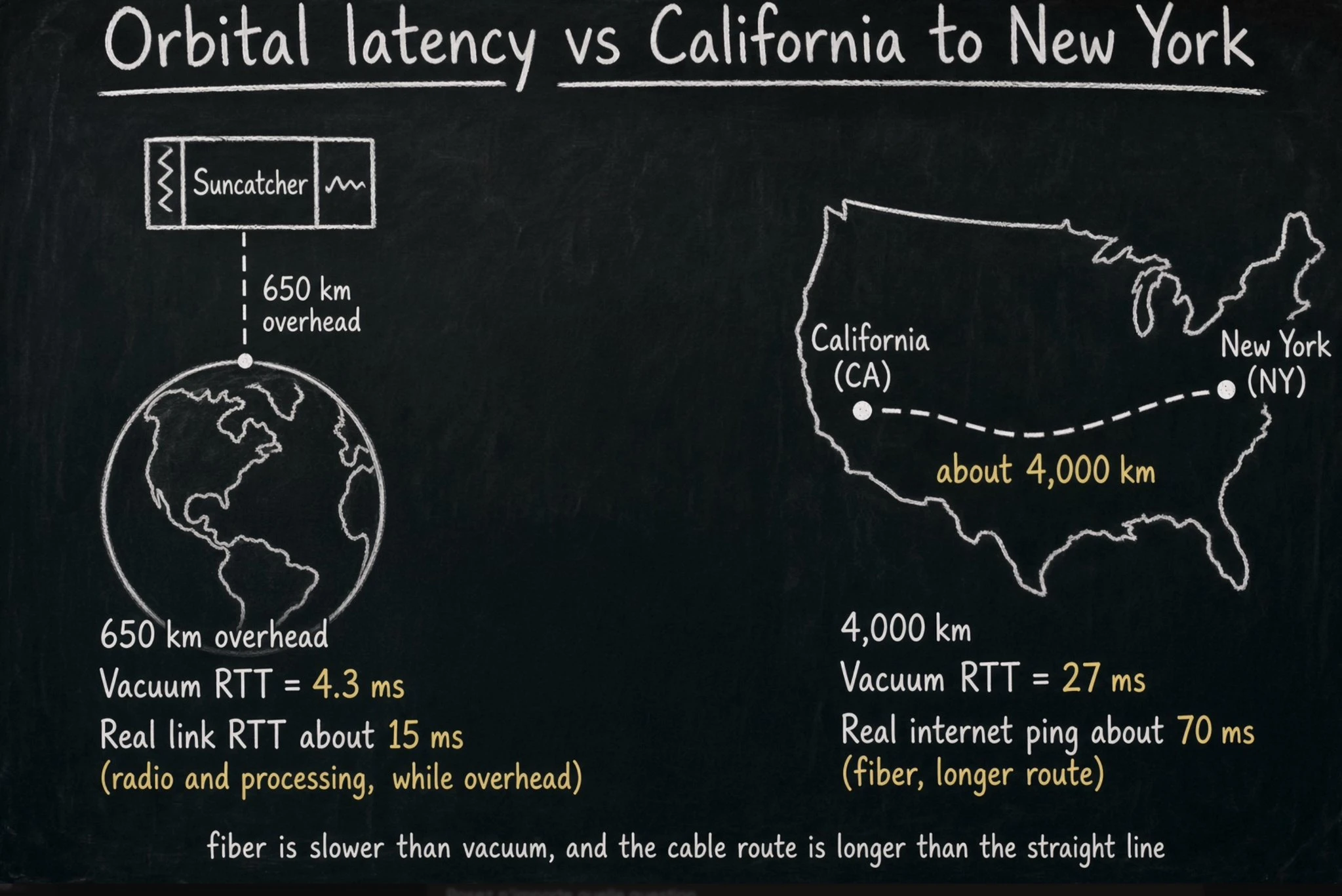
For people complaining that the latency is going to be a problem with orbital data centres…
An orbital data centre can be effectively in your line of sight and it can be relatively close (much closer than the diameter of the USA).

Further if you have a cluster of space data centres, they can remain close and in a line of sight.
So you are not going to run your video games or do high frequency trading from space, but for compute, latency is unlikely to be the bottleneck.
The great features are space (no need to wait five years for a permit) and power (no need to negotiate with a local government for electricity). Solar power in space is great because it runs 24h a day.
Daniel Lemire, "Google’s first orbital data center is in orbit," in Daniel Lemire's blog, October 4, 2026, https://lemire.me/blog/2026/10/04/googles-first-orbital-data-center-is-in-orbit/.
[BibTeX]

But you can’t get rid of heat easily. Thermal issues are underappreciated by people who never worked on satellites.
Compute in space is a very stupid idea. The downsides outweigh the benefits by far. Terrestrial DCs are cheaper, easier and friendlier to the environment.
All this crazyness only started because SpaceX needs future scalability potential for their IPO, now that Starlink has reduced need for more launches.
> An orbital data centre can be effectively in your line of sight and it can be relatively close (much closer than the diameter of the USA).
I don’t see how it’s going to be “much closer than the diameter of the USA” – that would only happen if you’re in a geosynchronous or geostationary orbit (at which point you’re not within 650 km of the surface).
They claim “dawn-dusk, sun-synchronous low-Earth orbit”, so the only time it’s “650km” away is during a narrow pass window and for the rest of the day it’s higher – when it’s dark at the that base station, the sattelite may be on the other side of the world. If it has base stations all over the world, then you have to account for the time to transmit terrestrially (and the distance will be much further than NY/CA), or account for the hops.
You have the orbits reversed. Geostationary is the far case, about 36,000 km up, which is why satellite TV has a noticeable delay. The close case is low Earth orbit.
Google’s sketch is a dawn-dusk sun-synchronous orbit at about 650 km. Overhead, the satellite is 650 km away. At the edge of a pass it is still only a few thousand kilometres away. The continental United States is about 4,500 km across, and a fibre path across it is slower than free-space light over the same distance (fibre is roughly two-thirds of c). So “closer than the diameter of the USA” is about a LEO pass, not about GEO.
You are right that one satellite is only in view for a short window. But the plan is to have a cluster in the same orbital plane, satellites a few hundred metres apart, linked by laser. Google’s layout is 81 satellites inside a 1 km radius. While any one of them can see a ground station, the job can sit anywhere in the cluster. You do not haul the bytes across the country on the ground, and you do not need the same satellite overhead all day.
The dawn-dusk orbit is there for power, not for coverage: near-constant sunlight, so the panels produce something like eight times an equivalent panel on the ground without batteries.
Thanks for cleaning up my paragraphs.
I see you’ve modified the post, adding an animation of the orbit.
Initially, there was a diagram, showing a satellite over the poll and a distance of 650km – which I assumed you were trying to show as being fixed in place – hence geosync/geostationary. I should have been more clear.
>But the plan is to have a cluster in the same orbital plane, satellites a few hundred metres apart, linked by laser. Google’s layout is 81 satellites inside a 1 km radius. While any one of them can see a ground station, the job can sit anywhere in the cluster. You do not haul the bytes across the country on the ground, and you do not need the same satellite overhead all day.
A 1 km radius swarm doesn’t mean that they are in view for that much longer than a single satellite – they are moving at 7km/s – so even if they swarm is 7 km, it’s only barely increasing the view time.
> While any one of them can see a ground station, the job can sit anywhere in the cluster. You do not haul the bytes across the country on the ground, and you do not need the same satellite overhead all day.
But you have to get the data to the ground station that is in view of the swarm you wish to communicate with, so you do have to haul it across the ground for that.
Perhaps I’m not seeing the use case that you are; are you firing data at the satellite in the couple hours of the day it’s within view (perhaps you can write down the calculation you’re making to see how long it’s in view?), and then you collect the data during the next window? Or are you saying that one swarm would laser contact another swarm, and data would hop until it gets to a swarm that can downlink? Because then the data is crossing (nearly) the same distance it would if it’s on the ground.
Obviously, you need to get the data to the base station wherever that is. And that base station can only ‘see’ one given orbital data center a few minutes a few times a day as the thing is spinning very fast from pole to pole. But for the few minutes that it is in view, the latency is quite good.
The point being that latency is not a major engineering constraint.
And they are very well isolated with vacuum, so cooling is not trivial to scale, as you can’t just evaporate water. Radiation is your best bet. It may well be the limiting factor for this 1kW PR gag.
The cost will be high but an interesting economic case might emerge where an orbital data center would make it possible to resolve otherwise unsatisfiable sets of regulatory requirements.