
26 October 2026 · 7 min
A lot of software spends its time mapping strings to values. A web server must identify the HTTP method (GET, POST, …). It must recognize header names. A URL parser must recognize the protocol (http, https, ftp, …). A compiler must recognize keywords.
In C++, the default approach is to put the strings in a std::unordered_map.
std::unordered_map<std::string_view, Method> methods = {
    {"GET", Method::GET}, {"POST", Method::POST}, {"PUT", Method::PUT},
    {"DELETE", Method::DELETE}, {"PATCH", Method::PATCH}};
It works. But notice something: the keys are known when you write the code. They never change. And yet we pay at runtime as if they could change at any time: we hash the whole string, we pick a bucket, we follow a pointer, we compare, maybe we walk a list.
Perfect hashing
A hash function maps keys to slots. When two keys land in the same slot, we have a collision, and we must deal with it. Collisions are what make hash tables complicated and slow.
If you know all of your keys ahead of time, you can construct a hash function designed for your keys, a function that never produces a collision. It is called a perfect hash function. The idea is old: the GNU gperf tool has been doing it since 1989. You give it a list of keywords, and it generates C code.
We follow the same design as gperf. The slot for a key is computed as follows.
slot = (length + asso[key[i]] + asso[key[j]] + ...) % table_size
We add the length of the key to a few small values taken from an association table (asso) indexed by the characters at a few selected positions. Usually, one or two positions are enough. The table size is a power of two, so the modulo is a single bitwise AND.
Consider the four HTTP methods GET, PUT, POST and DELETE. We use only the first character. Set asso['G'] = 0, asso['P'] = 1 and asso['D'] = 0. Then GET goes in slot 3 + 0 = 3, PUT goes in slot 3 + 1 = 4, POST goes in slot 4 + 1 = 5 and DELETE goes in slot 6 + 0 = 6. No collision.
To look up PUT, we compute the slot (4), and we compare PUT with the one key stored in slot 4. One hash, one comparison. If you look up PATCH, which is not in the set, you land in slot 5 + 1 = 6, you compare with DELETE, and you are done: not found. There is no probing, no chain to walk.
How do we find the association values? We sort the characters by how many keys they touch. We then take them one at a time and try 0, 1, 2, … until we find a value that does not cause a collision. We never revise a value once it is set. It is a greedy algorithm with bounded work. The bound matters because we do all of this at compile time, and C++ compilers limit how much work a constexpr function may do.
Doing it in C++
With our library, you write ordinary C++23. There is no external tool to run.
#include <ConstexprCore/perfect_hash.h>
using namespace ConstexprCore;
enum class Method { GET, POST, PUT, DELETE, PATCH };
constexpr auto methods = make_perfect_map<
    kv<"GET",    Method::GET>,
    kv<"POST",   Method::POST>,
    kv<"PUT",    Method::PUT>,
    kv<"DELETE", Method::DELETE>,
    kv<"PATCH",  Method::PATCH>
>();
The map is a compile-time constant. The compiler searches for the perfect hash function when it compiles your code. At runtime, computing the hash can take as few as four instructions: load one byte of the key, load one byte from the association table, add the length, apply a mask.
Comparing strings quickly
Computing the hash is cheap. But we still need to check that the string we are looking up matches the key stored in the slot. And comparing strings can be expensive: the textbook approach is a loop over the bytes with a branch for each byte. You can easily end up with dozens of instructions and several branches, and the branches are hard to predict when the strings vary.
Instead, we treat the key as a vector. Our processors, whether ARM or x64, have 16-byte registers. So we load 16 bytes unconditionally, even if the key is only three bytes long. We then use a shuffle instruction (tbl on ARM NEON) to zero the bytes past the end of the key. The stored keys are zero-padded at compile time. A single vector comparison handles the whole key. We go from about forty instructions and eight branches to five instructions and no branch.
But wait: is it safe to read 16 bytes when you only have three? Reading past the end of a buffer is fine as long as you do not cross into another memory page, and pages are at least 4 kilobytes. So we check whether the address is within 16 bytes of the end of its page. If it is, we take a slower path. Otherwise, we do the wide load. We traded several unpredictable branches for a single branch that is almost always taken the same way.
How fast is it?
I ran the benchmarks on an Apple M3 Max with AppleClang 15. We look up the keys in random order and we report the time per lookup. Let us first consider the 20 standard HTTP header names.
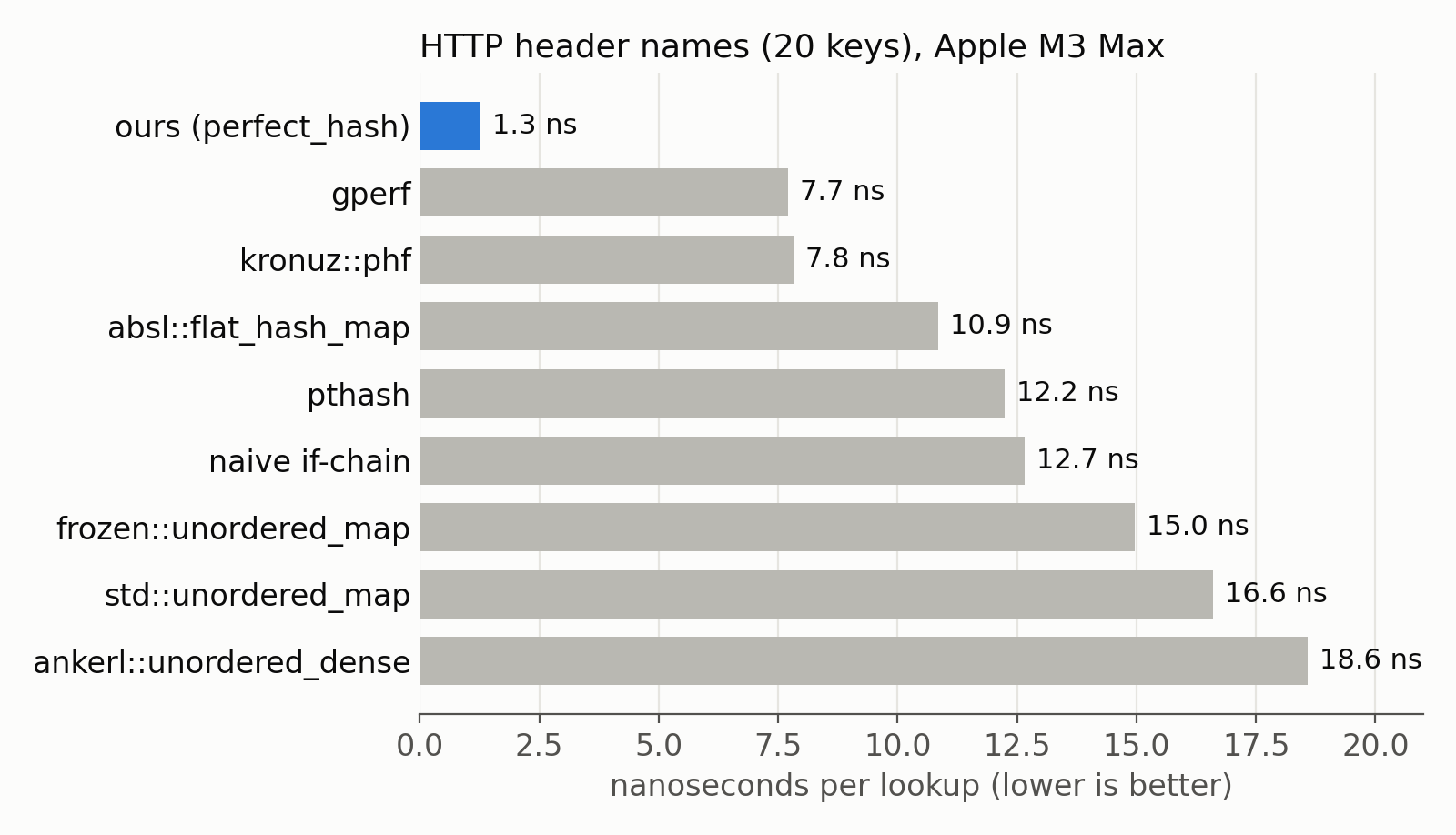
We need about 1.3 ns per lookup, or about 5 cycles. The classic gperf needs 7.7 ns. Abseil’s flat_hash_map, an excellent hash table, needs 10.9 ns. And std::unordered_map needs 16.6 ns. We are thirteen times faster than the standard library.
It is not one lucky key set. Here are the results over several sets of keys, from 6 URL protocols to the 100 tickers of the S&P 100.
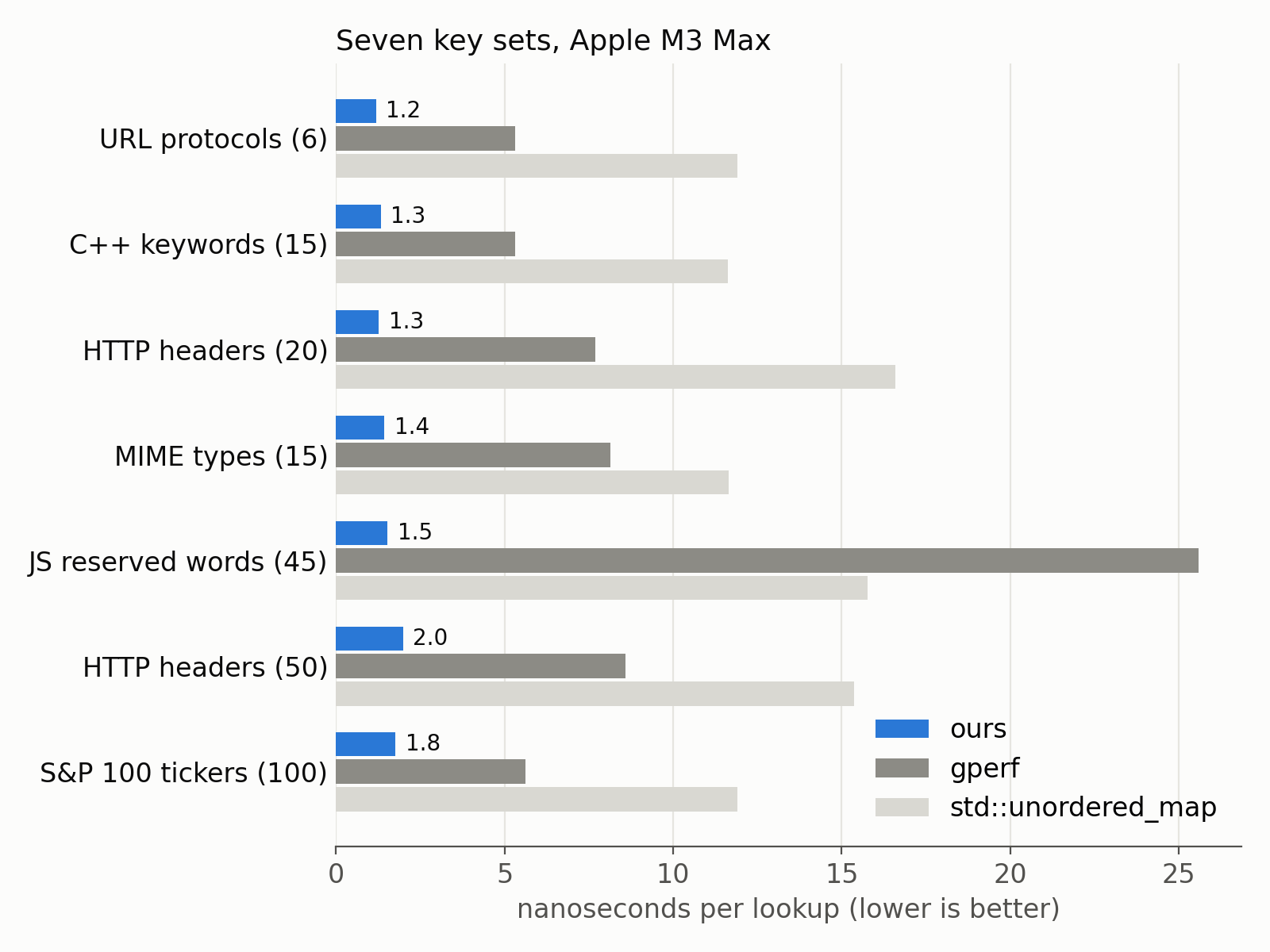
We stay between 1.2 ns and 2 ns per lookup. We are 3 to 6 times faster than gperf, and 7 to 13 times faster than std::unordered_map. Notice how gperf struggles with the JavaScript reserved words: there we are 17 times faster.
Why is std::unordered_map so much slower? The C++ standard essentially requires a chained hash table. A lookup hashes the whole string by calling a function, follows a pointer to a heap-allocated node and walks a list. Our lookup does a few loads and has no function call. The processor can retire over 8.6 instructions per cycle with our code, which is about as good as it gets on this chip, and it almost never mispredicts a branch.
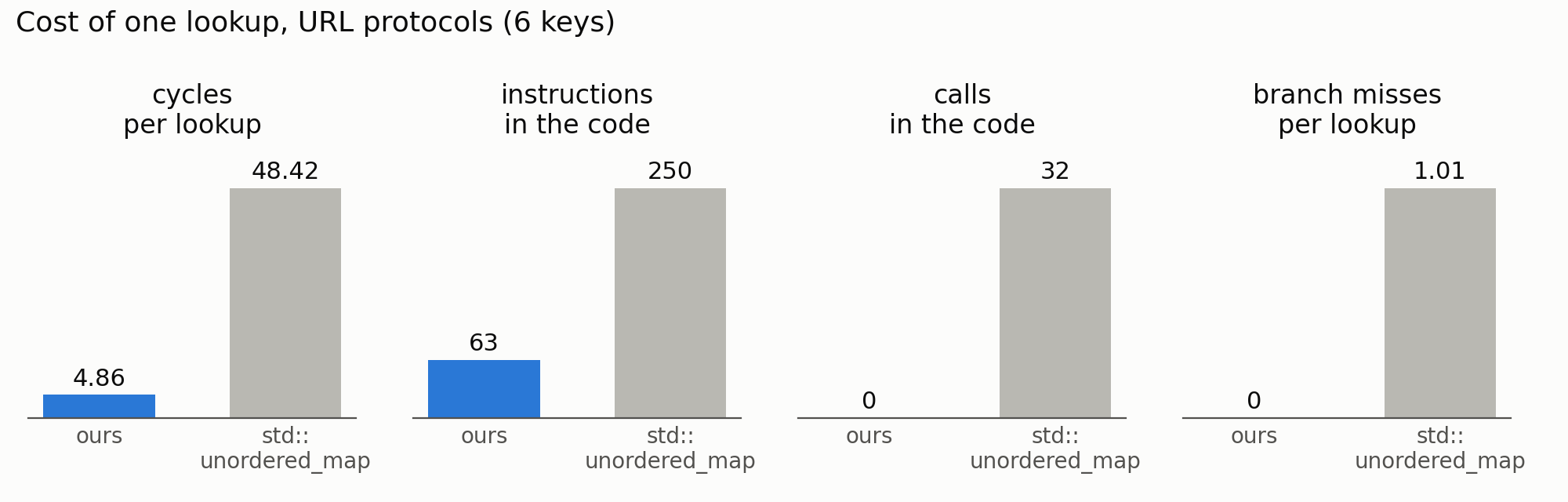
On an Apple M4, with the URL protocols, we exceed one billion lookups per second.
Conclusion
If your keys are known at compile time, you should not pay for collision handling at runtime. A perfect hash function gets you down to one comparison. With some care, a lookup costs about five cycles. The library is a single header you can drop in your project: github.com/ConstexprCore/perfect_hash.
This is joint work with Francisco Geiman Thiesen (Microsoft). We presented it at P99 CONF 2026. You can watch the talk on YouTube.
The benchmark numbers and the plotting script are available.
Daniel Lemire, "Billion-query-per-second lookup tables in C++," in Daniel Lemire's blog, October 26, 2026, https://lemire.me/blog/2026/10/26/billion-query-per-second-lookup-tables-in-c/.
[BibTeX]

Love your work!
Correct me if I’m wrong, but you can’t check set membership using perfect hash, so if someone sends an unknown HTTP operation, it’ll hash to the wrong value.
Is there a way to avoid this? A Bloom filter would tell if only if it does _not_ exist in the set.
WDYT?
You do need to compare with the expected key, you can’t avoid that.
You can store and check the hashes prior to reduction. There is a chance of collision but its quite small some use cases people are fine with this. A bit unsafe but usefull hack.
Nevermind I didn’t fully read the post. The unreduced hash check trick wont work here.
> But wait: is it safe to read 16 bytes when you only have three? Reading past the end of a buffer is fine as long as you do not cross into another memory page, and pages are at least 4 kilobytes.
I’d like to point out that while this may work *in practice, on a given target architecture*, it is technically undefined behavior as far as the C++ standard is concerned. It can produce any other result on conforming implementations of the C++ abstract machine (for example, but not limited to, gcc/clang with -fsanitizers, or fil-c, or any implementation that uses fat pointers).
Oh you do have to compare the key after you arrive at the perfect hash bucket. An infinite number of strings will hash to that place, so you can’t avoid the final comparison.
That’s correct.
> Reading past the end of a buffer is fine as long as you do not cross into another memory page, and pages are at least 4 kilobytes. So we check whether the address is within 16 bytes of the end of its page. If it is, we take a slower path. Otherwise, we do the wide load.
What about align-down then load to avoid the page bounds? 16 byte aligned load will not cross a page bound. strlen impls use this trick https://github.com/bminor/glibc/blob/master/string/strlen.c
I need to go to sleep. Align-down option for pages doesnt work that well for string comparisons even if one side is padded. Also page guard is well predicted.
> Reading past the end of a buffer is fine as long as you do not cross into another memory page, and pages are at least 4 kilobytes. So we check whether the address is within 16 bytes of the end of its page. If it is, we take a slower path. Otherwise, we do the wide load.
I avoid the need for the slow path, and the test for “nearly end of page”, by over-allocating the string buffers: always have 16 bytes allocated after the actual contents.
It can be a bit tricky / delicate to ensure that ALL your code complies with the over-allocation. And you need to keep the dual path function to deal with strings allocated outside of your control.
Thanks for the nice article, the vector compare with the page check is a neat trick!The CMakeLists.txt of perfect_hash pins unordered_dense to v4.5.0, which still used the old robin-hood index. Since 5.0 it uses a different index with 16 fingerprints per group, compared with SSE2 or NEON, so I reran your bench_protocol (commit 862ec56, unchanged) with 5.3.3 swapped in. Unfortunately I don’t have a Mac, so this is on a Ryzen 9 7950X, clang 22.1.8, -O3, libstdc++, pinned to one core, median of 5 runs. All hits, ns per lookup:
* URL protocols (6): 4.5.0 10.99, 5.3.3 8.02, std 12.50, absl 8.06
* C++ keywords (15): 4.5.0 13.22, 5.3.3 6.33, std 21.85, absl 6.18
* HTTP headers (20): 4.5.0 15.52, 5.3.3 7.93, std 21.21, absl 8.03
* MIME types (15): 4.5.0 8.19, 5.3.3 5.17, std 20.59, absl 5.37
* JS reserved words (45): 4.5.0 14.35, 5.3.3 7.58, std 16.26, absl 6.49
* HTTP headers (50): 4.5.0 16.79, 5.3.3 9.16, std 17.81, absl 9.01
* S&P 100 tickers (100): 4.5.0 15.87, 5.3.3 7.48, std 14.84, absl 7.24
So on this machine 5.3.3 is about 2x faster than 4.5.0, and more or less level with absl. On the JS reserved words absl is 17% faster. With HTTP headers, 4.5.0 had 0.92 branch misses per lookup, 5.3.3 has 0.54. For misses 5.3.3 is at 3.5 to 7.2 ns, the fastest of the four in all key sets.
To build it I had to disable the reflection examples, and pin Kronuz’s constexpr-phf to before July, because master deleted hashes.hh. I can’t say how this looks on the M3 with libc++, so it would be nice to see the chart with GIT_TAG v5.3.3. Of course none of this gets anywhere close to 1.3 ns, a perfect hash for a fixed key set is a different game 🙂
Thanks! Will update accordingly.
I wonder if it might be faster to switch on specific distinctive characters rather than bother with computing a hash function. I have code which automatically generates this kind of code for a given set of keys.
For example:
I don’t use an actual “switch” there but I’m pretty sure compiling with -O3 will yield the same result.
(Some may object to my indentation and brace style but I find that it facilitates manual refactoring.)
It just occurred to me that I could even shorten the strncmp calls to skip over the characters already checked. So instead of this:
I could do this:
But that might be “too clever by half” and possibly even slower.
On the other hand, the hash function method avoids the branching in my code. That branching may harm the performance in spite of its simple appearance. It has to compete with the blazingly fast branch-free arithmetic of the hash function.
I expect that you are using a micro-benchmark to test these hashing functions which will maximize all of their abilities to stay in the cache. However the increased locality of your implementation should greatly enhance its cacheability.
I expect the measured speedup might be even greater for more realistic benchmarks. E.g., in the case when the cache is churning enough that no implementation benefits from the cache, and even more when a more moderate degree of churn allows your implementation to make better use of the cache than the other implementations. Although when there is a significant body of code executing for each access of the hash table, the contribution of the hash to overall time would not be as significant.